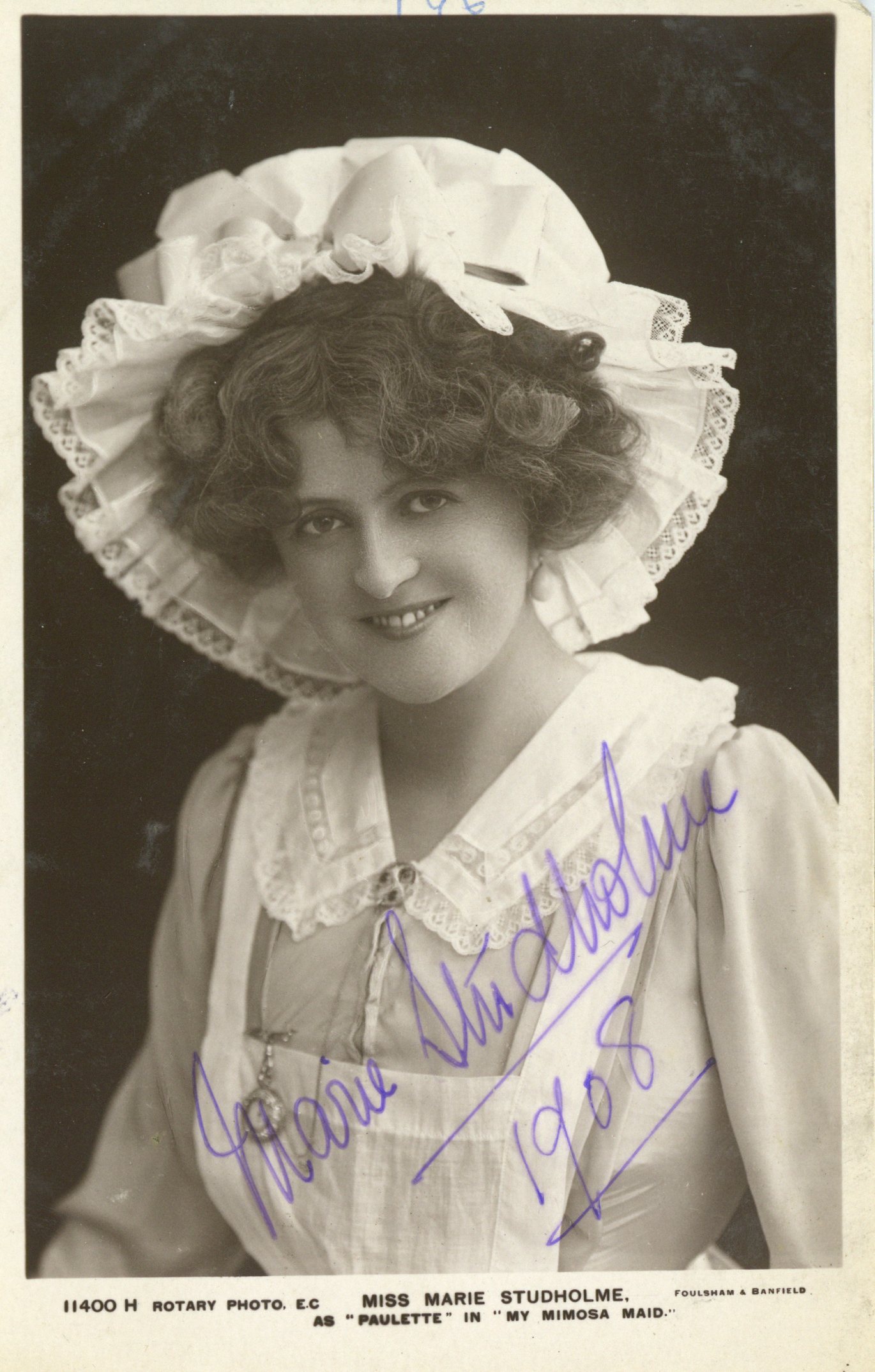
Marie Studholme - Postcard, 1908
Title
Marie Studholme - Postcard, 1908
Date
12 October 1908
Description
Promotional postcard of Marie Studholme, who starred in Frank Curzon's 1908 touring production of My Mimosa Maid.
What's the story?
Marie Studholme starred as Paulette in My Mimosa Maid at the Theatre Royal from 12 to 17 October 1908.
Described as ‘A Riviera Musical’, My Mimosa Maid was written by Paul Rubens and premiered in London in April 1908. It toured the UK later the same year.
Marie Studholme was a very popular actor and singer, particularly in musical comedies. She had later success in music hall, performing in songs and sketches until her retirement in 1915.
This was the second of two visits to the Theatre Royal Nottingham for Studholme in 1908. Earlier in the year, in February, she had starred in Miss Hook of Holland.
In a 1905 newspaper interview with the Manchester Courier Studholme revealed one of the problems she regular encounters due to being in the public eye. With the postcard boom of depicting attractive young actresses during this period, this is likely to have been a major problem for many other female performers.
“It appears that for some time past, Miss Studholme has been pestered by the attentions of a ‘gentleman’, who, obviously, is not blessed with that sense of fitness of things that one might desire. Day after day he has sent to her, through the medium of the Post Office, innumerable picture postcards, letters and even small parcels, all bearing the signature ‘George’. The picture postcards have been very varied in character, though many of them have borne Miss Studholme's own "counterfeit presentment," the blank space on the other side being filled up with all manner of communications, sometimes in English, and occasionally in French.
The letters and parcels have very often consisted of bundles of rubbishy paper such as cuttings from magazines, railway excursion bills, Atlantic liner booklets, and the like. Cuttings from commercial papers have been included, and where some ‘dry as dust’ article about stocks and shares, or something similar, has occurred, there has been a written request to ‘peruse this carefully.’ Needless to say, Miss Studholme has neither the time nor the inclination to read such matter, and when it was found that many of the communications make open reference to imaginary letters sent to the person in question by the lady herself, it is natural that Miss Studholme should be inclined to put a stop to such proceedings. Some of the letters, it may be mentioned, bear all kinds of written communications on the back, and all of them begin with the expression ‘My darling.’
Another curious part about it is that the more bulky letters and parcels are usually understamped, with the result that Miss Studholme has to pay the difference. This occurs sometimes two or three times in one day, and consequently the attentions of this person have become by now an absolute nuisance.
Miss Studholme has found that all the letters are sent to her, wherever she may chance to be, from Manchester, so it is evident that the mysterious ‘George’ has his home and habitation hereabouts. An alarming development of ‘George's’ antics occurred about two years ago, when a sensation was caused by the suicide, together, of two sisters in London. Details of the case appeared in many papers, and one illustrated journal gave photographs of the two girls. Miss Studholme received one day from George a copy of the photographs, and underneath was the inscription: ‘These two beautiful girls are now in Paradise, where you will shortly be.’
This naturally alarmed Miss Studholme, and though it was not possible to do anything at that time to prevent what appeared to be threat being carried out, she has always borne in mind the sinister suggestion contained in the letter. On visiting Manchester this time, she has placed the whole matter in the hands of the police, with what result remains to be seen. It is hoped, at any rate, that ‘George’ will be led to see the error of his ways and not to persist in such annoying practices.
‘I feel sorry for him,’ said Miss Studholme, to the 'Courier' representative, ‘and if I only knew where he lived, I could write and persuade him not to do such things. If he only knew it was an annoyance, I don't believe he would do it, but I hope he won't receive any severe treatment. He is not the only gentleman of this kind, however. Another individual is in the habit of sending me, every day, a picture postcard of myself, and underneath is written, in a foreign language, 'Darling Face.' He does not sign his name.’ “
This postcard forms part of a large scrapbook collection donated to the Theatre Royal archive by Diane Meadwell from Sandiacre. Her great grandfather was Bernard Hill, the former landlord of The Sun Inn on Parliament Street and who later became the Stage Door Keeper at the Theatre Royal. Bernard’s daughter Edith also worked at the Theatre Royal as an usherette.
Whilst in his stage door job, Bernard collected a large number of postcards of the numerous artists who performed at the venue, many of which he got them to autograph, as well as writing the date and if necessary the show on the reverse, making the future archivist’s job that little bit easier. We have then been able to cross-reference this information with the list of Theatre Royal shows being compiled by volunteer researcher Lynn Whitley.
We are grateful to Diane for sharing her family memories with us and for donating such a valuable resource to the archive.
Described as ‘A Riviera Musical’, My Mimosa Maid was written by Paul Rubens and premiered in London in April 1908. It toured the UK later the same year.
Marie Studholme was a very popular actor and singer, particularly in musical comedies. She had later success in music hall, performing in songs and sketches until her retirement in 1915.
This was the second of two visits to the Theatre Royal Nottingham for Studholme in 1908. Earlier in the year, in February, she had starred in Miss Hook of Holland.
In a 1905 newspaper interview with the Manchester Courier Studholme revealed one of the problems she regular encounters due to being in the public eye. With the postcard boom of depicting attractive young actresses during this period, this is likely to have been a major problem for many other female performers.
“It appears that for some time past, Miss Studholme has been pestered by the attentions of a ‘gentleman’, who, obviously, is not blessed with that sense of fitness of things that one might desire. Day after day he has sent to her, through the medium of the Post Office, innumerable picture postcards, letters and even small parcels, all bearing the signature ‘George’. The picture postcards have been very varied in character, though many of them have borne Miss Studholme's own "counterfeit presentment," the blank space on the other side being filled up with all manner of communications, sometimes in English, and occasionally in French.
The letters and parcels have very often consisted of bundles of rubbishy paper such as cuttings from magazines, railway excursion bills, Atlantic liner booklets, and the like. Cuttings from commercial papers have been included, and where some ‘dry as dust’ article about stocks and shares, or something similar, has occurred, there has been a written request to ‘peruse this carefully.’ Needless to say, Miss Studholme has neither the time nor the inclination to read such matter, and when it was found that many of the communications make open reference to imaginary letters sent to the person in question by the lady herself, it is natural that Miss Studholme should be inclined to put a stop to such proceedings. Some of the letters, it may be mentioned, bear all kinds of written communications on the back, and all of them begin with the expression ‘My darling.’
Another curious part about it is that the more bulky letters and parcels are usually understamped, with the result that Miss Studholme has to pay the difference. This occurs sometimes two or three times in one day, and consequently the attentions of this person have become by now an absolute nuisance.
Miss Studholme has found that all the letters are sent to her, wherever she may chance to be, from Manchester, so it is evident that the mysterious ‘George’ has his home and habitation hereabouts. An alarming development of ‘George's’ antics occurred about two years ago, when a sensation was caused by the suicide, together, of two sisters in London. Details of the case appeared in many papers, and one illustrated journal gave photographs of the two girls. Miss Studholme received one day from George a copy of the photographs, and underneath was the inscription: ‘These two beautiful girls are now in Paradise, where you will shortly be.’
This naturally alarmed Miss Studholme, and though it was not possible to do anything at that time to prevent what appeared to be threat being carried out, she has always borne in mind the sinister suggestion contained in the letter. On visiting Manchester this time, she has placed the whole matter in the hands of the police, with what result remains to be seen. It is hoped, at any rate, that ‘George’ will be led to see the error of his ways and not to persist in such annoying practices.
‘I feel sorry for him,’ said Miss Studholme, to the 'Courier' representative, ‘and if I only knew where he lived, I could write and persuade him not to do such things. If he only knew it was an annoyance, I don't believe he would do it, but I hope he won't receive any severe treatment. He is not the only gentleman of this kind, however. Another individual is in the habit of sending me, every day, a picture postcard of myself, and underneath is written, in a foreign language, 'Darling Face.' He does not sign his name.’ “
This postcard forms part of a large scrapbook collection donated to the Theatre Royal archive by Diane Meadwell from Sandiacre. Her great grandfather was Bernard Hill, the former landlord of The Sun Inn on Parliament Street and who later became the Stage Door Keeper at the Theatre Royal. Bernard’s daughter Edith also worked at the Theatre Royal as an usherette.
Whilst in his stage door job, Bernard collected a large number of postcards of the numerous artists who performed at the venue, many of which he got them to autograph, as well as writing the date and if necessary the show on the reverse, making the future archivist’s job that little bit easier. We have then been able to cross-reference this information with the list of Theatre Royal shows being compiled by volunteer researcher Lynn Whitley.
We are grateful to Diane for sharing her family memories with us and for donating such a valuable resource to the archive.
Type
Postcard
Location of item
Theatre Royal & Royal Concert Hall Nottingham
Rights
Theatre Royal & Royal Concert Hall Nottingham
Contributor
Researchers: David Longford / Lynn Whitley